Mould Testing Melbourne

Absolute Restoration Service provides property-based mould sampling and assessment support across Melbourne when testing is justified by a defined investigation, documentation or verification question.

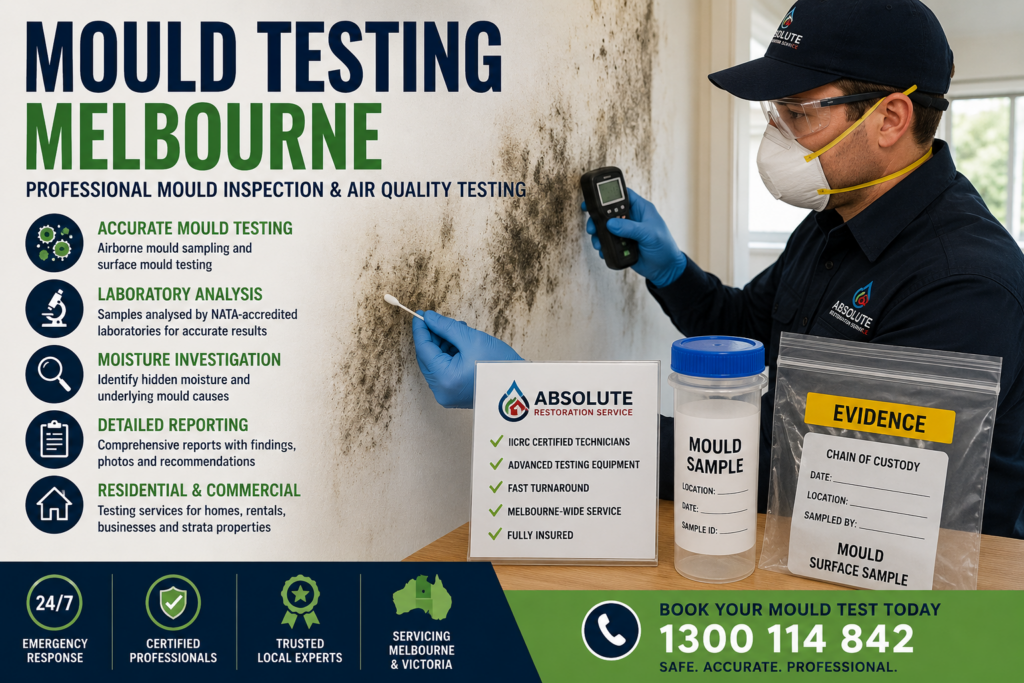
Testing may involve air, surface or material samples, supported by site observations and moisture information. A sample is one piece of evidence and should not be interpreted without considering the property, collection method, locations, timing and limitations.

Call 1300 114 842 to discuss the property and whether testing is appropriate for the intended purpose.

Property-based mould testing and sampling service in Melbourne
A useful sampling plan starts with a defined question, suitable locations and clearly stated limitations.

When Mould Testing May Be Useful

Mould testing is not automatically required. It may be considered when the result is expected to inform a practical decision, provide project documentation or address a specific uncertainty.

  • Suspected contamination is not readily visible
  • The type or distribution of growth is relevant to a defined investigation
  • A rental, strata, workplace or insurance process requires documented sampling
  • Baseline information is required before an agreed project
  • A qualified independent party requires post-remediation verification data
  • A specific surface, material or area needs targeted assessment

Testing should not delay obvious source repair, water extraction, drying or appropriate management of visible mould-affected materials.

When Testing May Not Be Necessary

When visible mould is present and the moisture source is evident, the immediate priorities may be source correction, moisture assessment and a suitable remediation scope. Collecting samples without a clear question can add cost without changing the required response.

Testing should not be used to claim that a building is entirely free of mould. Mould spores occur naturally indoors and outdoors, and no limited sampling plan can represent every room, cavity, surface or future condition.

Types of Mould Sampling

Air Sampling

Air samples collect particles from a defined volume of air over a limited period. Results can be influenced by doors and windows, ventilation, cleaning, weather, occupancy, recent disturbance and the sampling locations. Comparison or control samples may be relevant depending on the investigation design.

Surface Sampling

Tape lifts, swabs or other surface methods may assist with characterising growth on a selected area. A surface sample does not determine the full extent of contamination behind finishes or elsewhere in the property.

Material Sampling

A small portion of an affected material may be collected where laboratory assessment of that material is relevant. Sampling must consider permission, safe access, material disturbance and the limitations of the selected location.

Moisture Assessment Supports Interpretation

Mould growth is associated with moisture conditions. Relevant evidence may include visible water damage, material moisture readings, humidity observations, leak history, ventilation conditions and thermal imaging where useful.

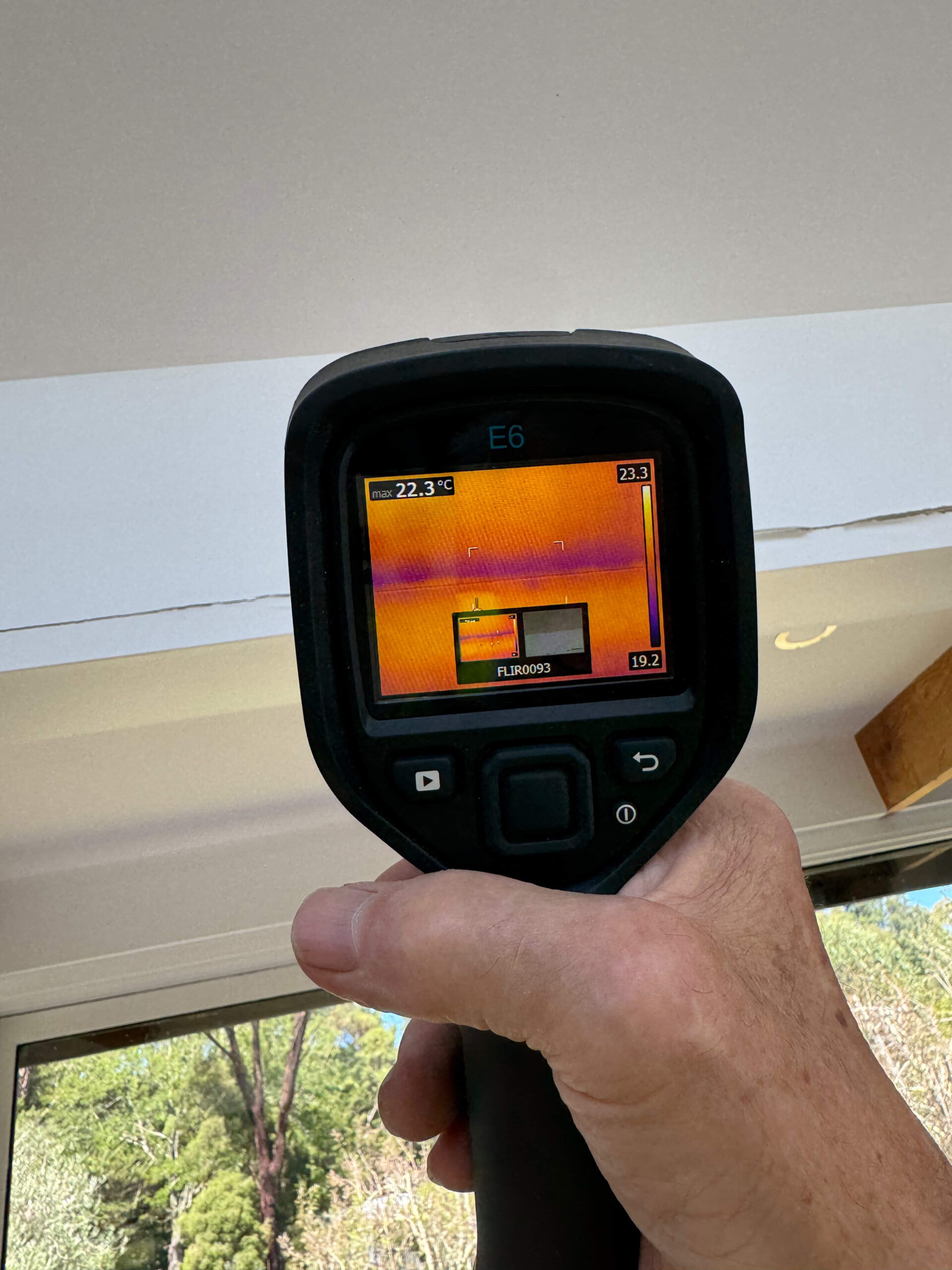
Thermal cameras record surface-temperature patterns. They do not see through walls and do not directly detect mould or water. Suspected anomalies require interpretation with readings, observations and available building information.
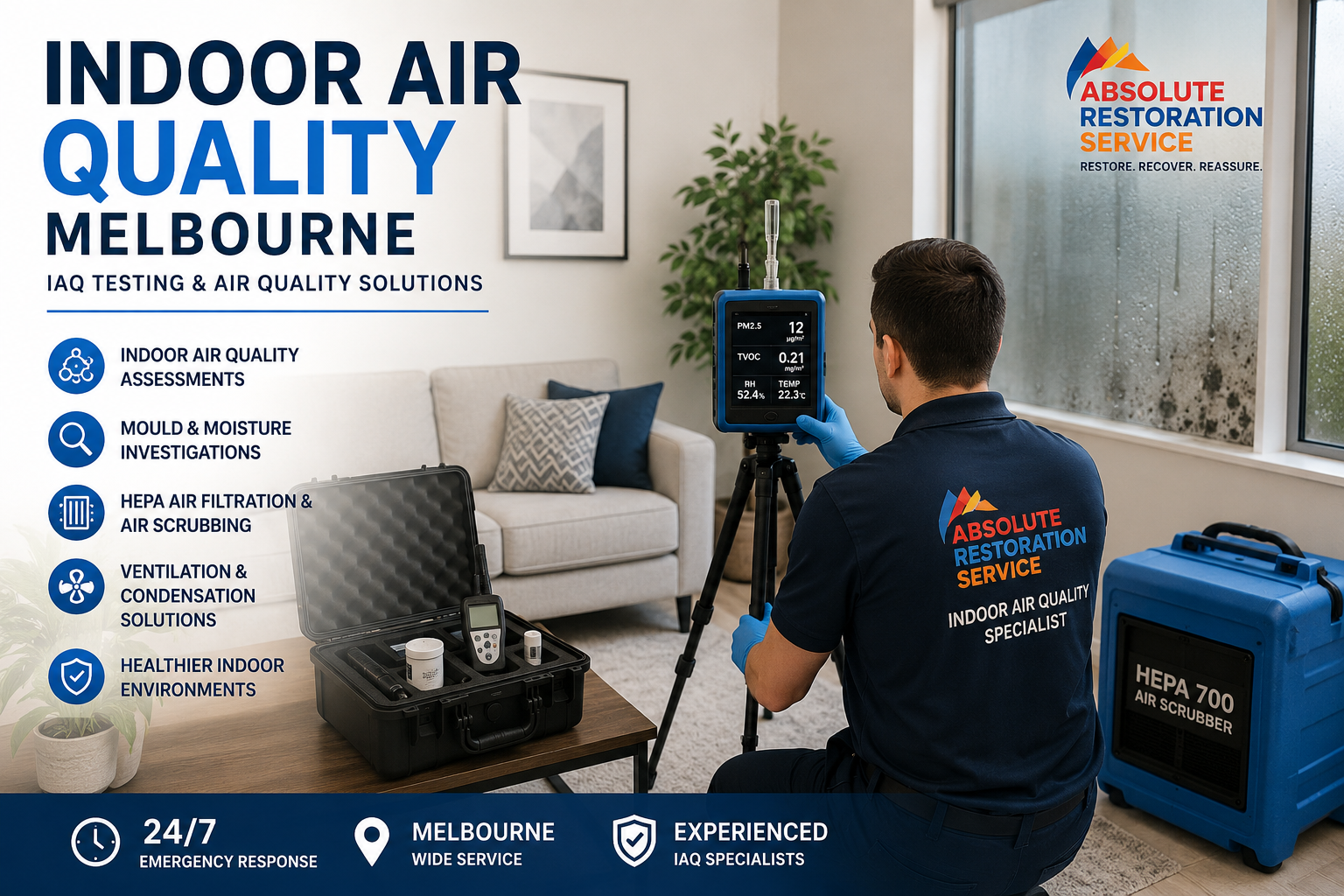
Indoor air sampling equipment used during a Melbourne mould assessment
Air sampling represents a selected place and time, not every area of a property.
Thermal imaging used with moisture readings during a Melbourne mould investigation
Thermal patterns require confirmation with moisture readings and site observations.

Our Mould-Testing Process

  1. Define the question: clarify why testing is being considered and what decision the result should support.
  2. Review the property: discuss the history, visible conditions, previous water events, repairs and access.
  3. Plan the sampling: select suitable methods, locations, comparisons and laboratory analysis for the agreed purpose.
  4. Document conditions: record relevant observations and limitations at the time of collection.
  5. Collect samples: use suitable handling, labelling and chain-of-custody procedures.
  6. Laboratory analysis: submit samples to the nominated laboratory under the agreed service level.
  7. Interpret the results: consider laboratory findings alongside the sampling design, property conditions and limitations.
  8. Recommend next steps: outline practical actions or referrals relevant to the agreed scope.

Understanding Laboratory Results

Laboratory results may identify or quantify material collected from the selected sample. Interpretation depends on the method, sample volume or area, detection limits, environmental conditions and investigation question.

A result should not be read as a medical diagnosis, a legal finding or proof that one source caused all contamination. Numerical results from different methods, laboratories, dates or locations may not be directly comparable without appropriate context.

Rental, Strata and Commercial Testing

ARS assists authorised owners, renters, property managers, owners-corporation representatives and business operators. Confirm access rights and any insurer, landlord, workplace or owners-corporation requirements before sampling.

In strata buildings, investigation may involve private lots, common property or shared services. ARS documents accessible property conditions but does not determine legal liability, lot boundaries or insurance coverage.

Post-Remediation Verification

Completion criteria should be agreed before remediation begins. A project review may consider visual cleanliness, absence of debris and unresolved odours, material condition, moisture targets and completion of the defined scope.

Where independent post-remediation verification or clearance sampling is required, it should be performed by an appropriately qualified party independent of the remediation contractor.

Important Testing Limitations

  • Samples represent selected locations and collection periods only.
  • Concealed cavities and inaccessible materials are not represented unless specifically investigated.
  • Weather, ventilation, cleaning, occupancy and recent disturbance can influence results.
  • No limited sample can establish that an entire property is free of mould.
  • Property testing does not diagnose illness or establish health causation.

People with health concerns should consult an appropriate healthcare professional.

Related Assessment and Remediation Services

Discuss Mould Testing in Melbourne

Call 1300 114 842 or contact Absolute Restoration Service online. Include the property type, reason for testing, affected areas, known water events and any documentation requirements.

Mould Testing Melbourne FAQs

Is mould testing always necessary?

No. Testing should answer a defined question and is not automatically required when visible mould and a clear moisture problem are already present. The proposed method, purpose and limitations should be explained before sampling.

What types of mould samples can be collected?

Depending on the question and site conditions, a scope may consider air, surface or material samples. The selected method, locations and comparison strategy affect what can reasonably be interpreted.

Can a mould test prove that mould caused health symptoms?

No. Property testing does not diagnose illness or establish that symptoms were caused by mould. People with health concerns should consult an appropriate healthcare professional.

Can one air sample represent the whole property?

No. A sample represents the selected location and collection period under the conditions at that time. It cannot represent every room, cavity, surface or future condition.

How long do laboratory results take?

Turnaround depends on the laboratory, method and requested service level. The expected timeframe should be confirmed when the sampling scope is agreed.

Who should perform post-remediation verification?

Where independent verification is required, it should be completed by an appropriately qualified party independent of the remediation contractor, using completion criteria agreed before remediation begins.